Should You Repair or Replace Your Boiler? A Cost Comparison
A boiler breakdown is frustrating, inconvenient, and often expensive. When your system stops working, one of the biggest…

Why you can trust our content
We understand that the boiler industry can be confusing, with plenty of outdated or misleading information. That’s why we rely only on trusted, proven sources to guide our advice and installations:
A boiler breakdown is frustrating, inconvenient, and often expensive. When your system stops working, one of the biggest questions homeowners face is whether it’s worth repairing the existing boiler or if replacing it would be the smarter long-term decision.
The choice isn’t always straightforward. While some issues can be repaired quickly and affordably, other faults signal that your boiler is nearing the end of its life. In these cases, investing in a replacement can offer better reliability, improved energy efficiency and reduced heating bills.
As heating specialists serving homeowners across Glasgow, Origin GPH helps customers make informed decisions every day. This guide breaks down the differences between repairing and replacing, highlighting the true costs, benefits and long-term value of each option. If you’re trying to understand boiler replacement cost or new boiler cost in Glasgow, you’ll find everything you need here.
Why the Repair vs Replacement Decision Matters
Choosing the wrong option can be costly.
- Repairing a failing boiler again and again can cost hundreds each year.
- Replacing a boiler too early may mean spending money unnecessarily.
Knowing the signs and understanding the cost comparison ensures you make the best financial decision for your home.
Common Boiler Problems and Their Typical Repair Costs
Before deciding whether to replace your boiler, you need to understand what common faults cost to fix. Below are typical UK repair costs:
|
Fault Type |
Typical Repair Cost |
|
Low pressure / simple reset |
£70–£120 |
|
Thermostat replacement |
£80–£200 |
|
Fan replacement |
£125–£300 |
|
Pump replacement |
£150–£350 |
|
Diverter valve replacement |
£150–£350 |
|
PCB (Printed Circuit Board) replacement |
£200–£500 |
|
Heat exchanger replacement |
£300–£600+ |
|
Leak repair |
£90–£300 |
|
System power flush |
£350–£600 |
These figures vary by boiler brand, age and condition. If the repair cost is low and your boiler is still relatively young, repairing can make perfect sense.
However, expensive faults — especially those involving the heat exchanger, PCB or pump — often raise the question of whether the money is better put towards a replacement.
When Repair Makes the Most Sense
1. Your boiler is under 10 years old
Most modern boilers are designed to last around 12–15 years. If your boiler is under 10 and has a good service history, repairing is usually more economical.
2. The repair is minor
Simple issues, such as pressure loss, ignition faults or thermostat problems, are affordable to fix and don’t justify a full replacement.
3. Parts are still readily available
Repairs are quicker and cheaper when components are easy to source.
4. This is your first major issue
If your boiler has been reliable in the past, a repair can extend its lifespan without significant cost.
5. Your heating bills haven’t risen dramatically
If efficiency is still acceptable, replacement may not be necessary.
When Replacement Is the Better Option
1. Your boiler is over 12–15 years old
Older boilers naturally become less efficient and more prone to faults. At this age, replacement often becomes more cost-effective.
2. Repairs are becoming frequent
If you’ve had multiple breakdowns in the last 1–2 years, the long-term cost of repairs can exceed the price of a new boiler.
3. Major components have failed
Costly faults such as a failed heat exchanger or PCB often signal the end of a boiler’s economical lifespan.
4. Your heating bills are rising
Old boilers lose efficiency, resulting in higher energy usage.
5. Replacement parts are hard to source
If parts are no longer manufactured, repairing becomes increasingly impractical.
6. You have safety concerns
Frequent leaks, overheating or ignition issues may indicate that the boiler is no longer safe to operate.
What kind of fuel does your boiler use?
Mains Gas
LPG
It just takes 2 minutes
And then you can book a free consultation
Boiler Replacement Cost: What Influences the Price?
Replacing a boiler involves more than just the cost of the appliance. The total boiler replacement cost depends on several factors:
1. Boiler type
- Combi boilers: £1,800–£2,800
- System boilers: £2,000–£3,200
- Regular boilers: £2,200–£3,500
These estimates include installation.
2. Brand and model
Premium brands (Worcester Bosch, Vaillant) cost more upfront but offer better reliability. Budget brands (Ideal, Glow-worm) are more affordable but may require more future maintenance.
3. Complexity of installation
Costs rise if you require:
- Boiler relocation
- Pipework upgrades
- Flue replacement
- New thermostat
4. Property size
Larger homes require boilers with higher output.
5. Energy efficiency rating
High-efficiency boilers may cost more upfront but save more in the long run.
6. Additional system upgrades
You may also need:
- Magnetic filter installation
- System flush
- Smart thermostat
- New radiators
All these can influence the final cost.
New Boiler Cost Glasgow: What Homeowners Can Expect
In Glasgow, pricing can vary depending on the engineer, the type of boiler and the complexity of installation. Here’s a typical breakdown of new boiler cost in Glasgow:
Combi boiler installation
£1,800–£2,800
(ideal for most modern households)
System boiler installation
£2,000–£3,200
(suited to larger properties with higher hot water demand)
Regular boiler installation
£2,200–£3,500
(best for older heating systems with tanks)
These ranges include labour, parts and standard installation items.
Origin GPH offers clear, competitive pricing for boiler replacements, ensuring no hidden charges.
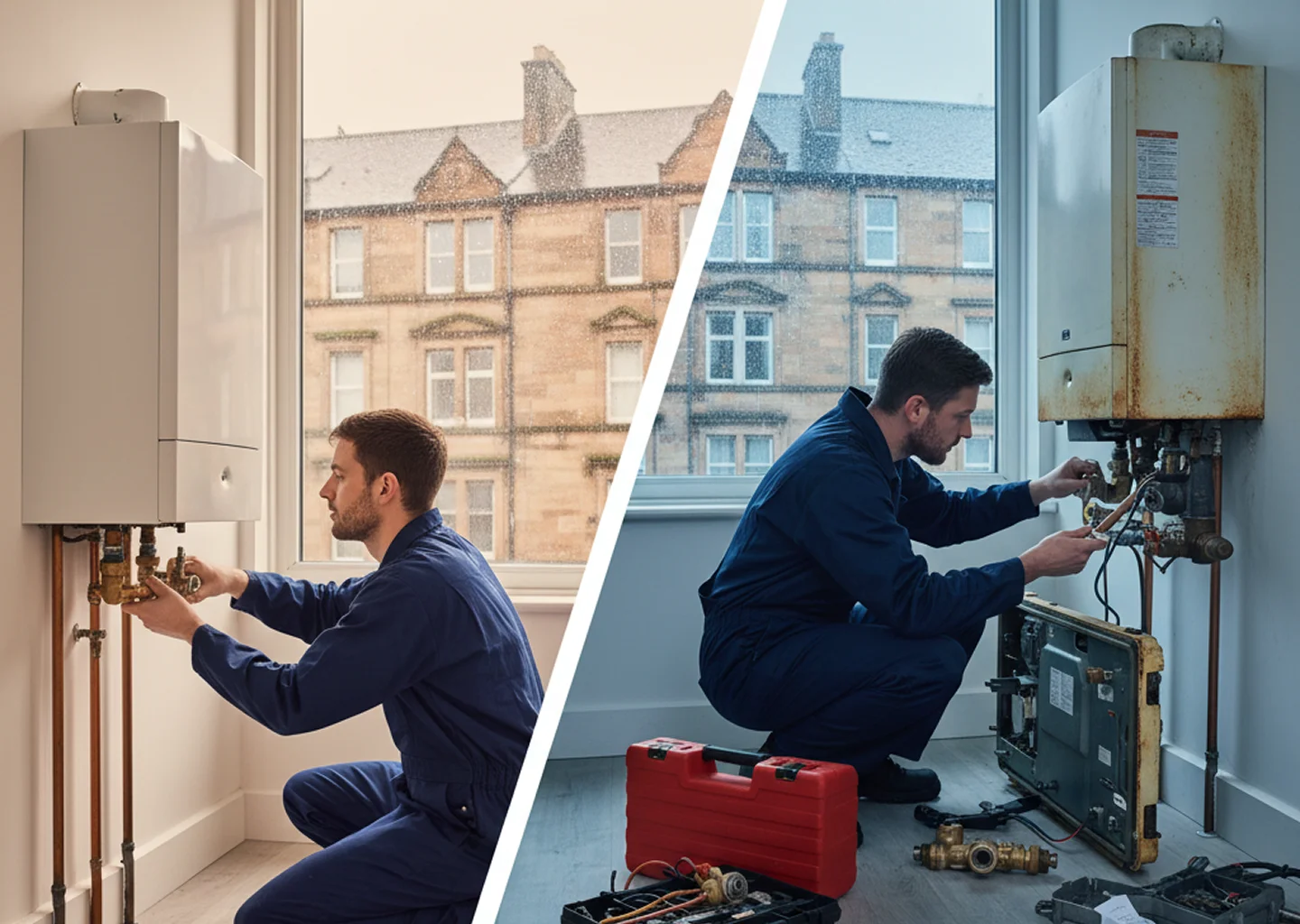
Cost Comparison: Repairing vs Replacing
To help you decide, here’s a side-by-side comparison.
Repairing may cost:
- £70–£600+
- Immediate solution
- No major disruption
- Short-term savings
But it may also mean:
- More repairs down the line
- Lower efficiency
- Higher bills
- Shorter lifespan remaining
Replacing may cost:
- £1,800–£3,500+
- Long-term investment
- Increased efficiency (A-rated)
- Lower gas bills
- Fewer future repairs
- Improved safety
- Higher home value
How to Decide: A Simple Decision Framework
Use this quick checklist to guide your choice.
Choose REPAIR if:
- The boiler is under 10 years old
- It’s the first major fault
- The repair cost is under £300
- Parts are readily available
- Efficiency is still acceptable
Choose REPLACE if:
- The boiler is 12–15+ years old
- Repair cost exceeds £400–£500
- Breakdown frequency has increased
- Major components have failed
- Heating bills are noticeably high
- You want lower long-term energy costs
The Long-Term Financial Impact
Efficiency savings
Old G-rated boilers operate at around 60% efficiency.
Modern A-rated boilers operate at 90%+.
For many households, this can save £200–£350 per year on energy bills.
Reduced repair costs
New boilers typically come with:
- Manufacturer warranties (5–10 years)
- Lower risk of breakdown
- Reduced maintenance costs
Increased property value
A new heating system is a selling point for potential buyers.
Why Many Glasgow Homeowners Choose Replacement Over Repair
Glasgow’s winters are long and cold, making reliability essential. For many homeowners, the peace of mind that comes with a new boiler outweighs the cost of ongoing repairs.
Origin GPH has seen hundreds of cases where replacement offered:
- Better long-term value
- More reliable heating
- Lower annual costs
- Improved safety
- Better system performance
Why Choose Origin GPH for Boiler Repair or Replacement?
Origin GPH is trusted across Glasgow for expert boiler installations and high-quality repairs.
What we provide:
- Fully qualified Gas Safe engineers
- Transparent, fixed pricing
- Honest advice with no upselling
- Support for all major boiler brands
- Fast installation times
- Extended warranties on new boilers
- Local Glasgow expertise
We always assess your home, your heating needs and your budget before recommending repair or replacement.
Deciding whether to repair or replace your boiler can be challenging, especially when costs vary widely. If the boiler is still relatively young and the fault is minor, repairing is usually the most sensible choice. However, if the boiler is old, inefficient or requiring costly parts, investing in a replacement is often the better long-term decision.
Understanding boiler replacement cost and new boiler cost in Glasgow helps you make a confident, informed choice for your home and budget.
Contact Origin GPH today for expert advice, competitive boiler replacement pricing and reliable boiler repairs across Glasgow.
Related articles
What kind of fuel does your boiler use?
Mains Gas
LPG
Key Boiler Repair vs Replacement Considerations
A boiler breakdown is frustrating, inconvenient, and often expensive. When your system stops working, one of the biggest questions homeowners face is whether it’s worth repairing the existing boiler or if replacing it would be the smarter long-term decision.
The choice isn’t always straightforward. While some issues can be repaired quickly and affordably, other faults signal that your boiler is nearing the end of its life. In these cases, investing in a replacement can offer better reliability, improved energy efficiency and reduced heating bills.
As heating specialists serving homeowners across Glasgow, Origin GPH helps customers make informed decisions every day. This guide breaks down the differences between repairing and replacing, highlighting the true costs, benefits and long-term value of each option. If you’re trying to understand boiler replacement cost or new boiler cost in Glasgow, you’ll find everything you need here.
Why the Repair vs Replacement Decision Matters
Choosing the wrong option can be costly.
- Repairing a failing boiler again and again can cost hundreds each year.
- Replacing a boiler too early may mean spending money unnecessarily.
Knowing the signs and understanding the cost comparison ensures you make the best financial decision for your home.
Common Boiler Problems and Their Typical Repair Costs
Before deciding whether to replace your boiler, you need to understand what common faults cost to fix. Below are typical UK repair costs:
|
Fault Type |
Typical Repair Cost |
|
Low pressure / simple reset |
£70–£120 |
|
Thermostat replacement |
£80–£200 |
|
Fan replacement |
£125–£300 |
|
Pump replacement |
£150–£350 |
|
Diverter valve replacement |
£150–£350 |
|
PCB (Printed Circuit Board) replacement |
£200–£500 |
|
Heat exchanger replacement |
£300–£600+ |
|
Leak repair |
£90–£300 |
|
System power flush |
£350–£600 |
These figures vary by boiler brand, age and condition. If the repair cost is low and your boiler is still relatively young, repairing can make perfect sense.
However, expensive faults — especially those involving the heat exchanger, PCB or pump — often raise the question of whether the money is better put towards a replacement.
When Repair Makes the Most Sense
1. Your boiler is under 10 years old
Most modern boilers are designed to last around 12–15 years. If your boiler is under 10 and has a good service history, repairing is usually more economical.
2. The repair is minor
Simple issues, such as pressure loss, ignition faults or thermostat problems, are affordable to fix and don’t justify a full replacement.
3. Parts are still readily available
Repairs are quicker and cheaper when components are easy to source.
4. This is your first major issue
If your boiler has been reliable in the past, a repair can extend its lifespan without significant cost.
5. Your heating bills haven’t risen dramatically
If efficiency is still acceptable, replacement may not be necessary.
When Replacement Is the Better Option
1. Your boiler is over 12–15 years old
Older boilers naturally become less efficient and more prone to faults. At this age, replacement often becomes more cost-effective.
2. Repairs are becoming frequent
If you’ve had multiple breakdowns in the last 1–2 years, the long-term cost of repairs can exceed the price of a new boiler.
3. Major components have failed
Costly faults such as a failed heat exchanger or PCB often signal the end of a boiler’s economical lifespan.
4. Your heating bills are rising
Old boilers lose efficiency, resulting in higher energy usage.
5. Replacement parts are hard to source
If parts are no longer manufactured, repairing becomes increasingly impractical.
6. You have safety concerns
Frequent leaks, overheating or ignition issues may indicate that the boiler is no longer safe to operate.
What kind of fuel does your boiler use?
Mains Gas
LPG
It just takes 2 minutes
And then you can book a free consultation
Boiler Replacement Cost: What Influences the Price?
Replacing a boiler involves more than just the cost of the appliance. The total boiler replacement cost depends on several factors:
1. Boiler type
- Combi boilers: £1,800–£2,800
- System boilers: £2,000–£3,200
- Regular boilers: £2,200–£3,500
These estimates include installation.
2. Brand and model
Premium brands (Worcester Bosch, Vaillant) cost more upfront but offer better reliability. Budget brands (Ideal, Glow-worm) are more affordable but may require more future maintenance.
3. Complexity of installation
Costs rise if you require:
- Boiler relocation
- Pipework upgrades
- Flue replacement
- New thermostat
4. Property size
Larger homes require boilers with higher output.
5. Energy efficiency rating
High-efficiency boilers may cost more upfront but save more in the long run.
6. Additional system upgrades
You may also need:
- Magnetic filter installation
- System flush
- Smart thermostat
- New radiators
All these can influence the final cost.
New Boiler Cost Glasgow: What Homeowners Can Expect
In Glasgow, pricing can vary depending on the engineer, the type of boiler and the complexity of installation. Here’s a typical breakdown of new boiler cost in Glasgow:
Combi boiler installation
£1,800–£2,800
(ideal for most modern households)
System boiler installation
£2,000–£3,200
(suited to larger properties with higher hot water demand)
Regular boiler installation
£2,200–£3,500
(best for older heating systems with tanks)
These ranges include labour, parts and standard installation items.
Origin GPH offers clear, competitive pricing for boiler replacements, ensuring no hidden charges.
Cost Comparison: Repairing vs Replacing
To help you decide, here’s a side-by-side comparison.
Repairing may cost:
- £70–£600+
- Immediate solution
- No major disruption
- Short-term savings
But it may also mean:
- More repairs down the line
- Lower efficiency
- Higher bills
- Shorter lifespan remaining
Replacing may cost:
- £1,800–£3,500+
- Long-term investment
- Increased efficiency (A-rated)
- Lower gas bills
- Fewer future repairs
- Improved safety
- Higher home value
How to Decide: A Simple Decision Framework
Use this quick checklist to guide your choice.
Choose REPAIR if:
- The boiler is under 10 years old
- It’s the first major fault
- The repair cost is under £300
- Parts are readily available
- Efficiency is still acceptable
Choose REPLACE if:
- The boiler is 12–15+ years old
- Repair cost exceeds £400–£500
- Breakdown frequency has increased
- Major components have failed
- Heating bills are noticeably high
- You want lower long-term energy costs
The Long-Term Financial Impact
Efficiency savings
Old G-rated boilers operate at around 60% efficiency.
Modern A-rated boilers operate at 90%+.
For many households, this can save £200–£350 per year on energy bills.
Reduced repair costs
New boilers typically come with:
- Manufacturer warranties (5–10 years)
- Lower risk of breakdown
- Reduced maintenance costs
Increased property value
A new heating system is a selling point for potential buyers.
Why Many Glasgow Homeowners Choose Replacement Over Repair
Glasgow’s winters are long and cold, making reliability essential. For many homeowners, the peace of mind that comes with a new boiler outweighs the cost of ongoing repairs.
Origin GPH has seen hundreds of cases where replacement offered:
- Better long-term value
- More reliable heating
- Lower annual costs
- Improved safety
- Better system performance
Why Choose Origin GPH for Boiler Repair or Replacement?
Origin GPH is trusted across Glasgow for expert boiler installations and high-quality repairs.
What we provide:
- Fully qualified Gas Safe engineers
- Transparent, fixed pricing
- Honest advice with no upselling
- Support for all major boiler brands
- Fast installation times
- Extended warranties on new boilers
- Local Glasgow expertise
We always assess your home, your heating needs and your budget before recommending repair or replacement.
Deciding whether to repair or replace your boiler can be challenging, especially when costs vary widely. If the boiler is still relatively young and the fault is minor, repairing is usually the most sensible choice. However, if the boiler is old, inefficient or requiring costly parts, investing in a replacement is often the better long-term decision.
Understanding boiler replacement cost and new boiler cost in Glasgow helps you make a confident, informed choice for your home and budget.
Contact Origin GPH today for expert advice, competitive boiler replacement pricing and reliable boiler repairs across Glasgow.